
A field of study for environmental science.
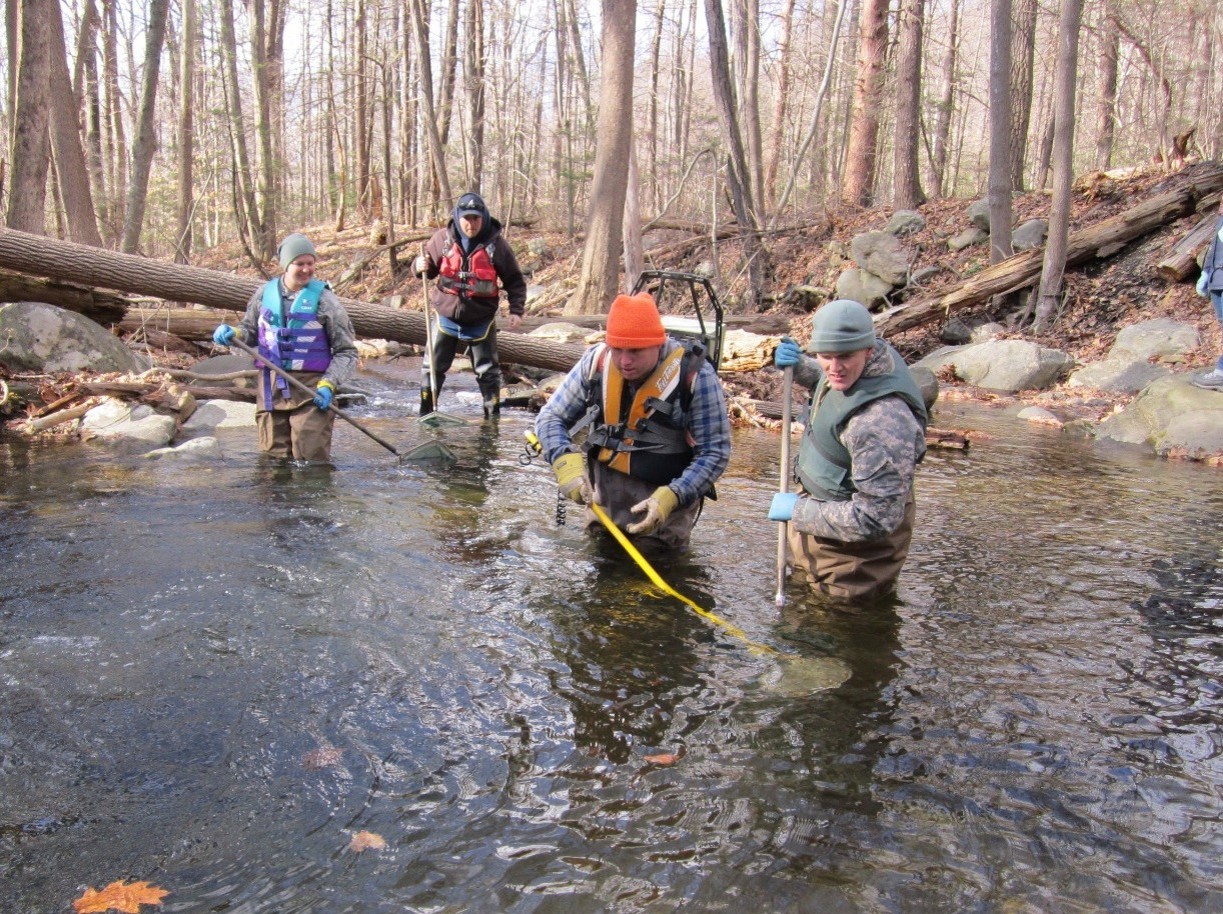
Fish size and assemblage patterns following dam failure in Black Rock Brook New York
Key Words: dam removal • fish assemblages • species diversity • stream ecology • morphometrics • ecological monitoring
The study, published in Journal of Freshwater Ecology and authored by Environmental Science faculty member CPT Alaina McLaughlin and a fellow 2017 West Point classmate, builds on research the two authors conducted together as cadets investigating fish populations in Black Rock Brook, New York. After a hurricane caused the Cornwall Lower Reservoir dam to fail in 2011, the authors were able to compare fish data collected before the failure in 2010 with surveys of the same stream reaches conducted in 2017. The post-failure survey documented significantly smaller blacknose dace and lower observed fish species richness and diversity both above and below the former dam, demonstrating that ecological responses to barrier loss can extend throughout a stream and vary among species. The findings highlight the importance of long-term ecological monitoring while demonstrating how baseline data collected through cadet research can provide lasting value for understanding environmental change and guiding future management decisions.
To cite this article: McLaughlin A. & McConnell, H. (2026). Fish size and assemblage patterns following dam failure in Black Rock Brook, New York, Journal of Freshwater Ecology, 41:1, 2703163, DOI: https://doi.org/10.1080/02705060.2026.2703163
Want to know more? Click here to read the full paper!

A matrix approach to visually communicate simultaneously the environmental and health impacts of foods
Key Words: environmental sustainability • human health • food groups • relative risk • health index
The study, published in Frontiers in Nutrition and co-authored by West Point faculty member Andrew Berardy, introduces a visual matrix designed to simultaneously communicate the environmental and health impacts of 30 commonly consumed food groups in the United States. Researchers aggregated data on carbon footprints and relative disease risks to categorize foods, demonstrating that plant-based, less-processed options generally offer favorable health benefits and lower carbon footprints compared to animal-based and highly processed alternatives. By intuitively highlighting the tradeoffs of various dietary choices, this matrix provides a practical tool for quickly evaluating sustainability and health outcomes. Ultimately, this accessible framework encourages more informed decision-making among consumers, policymakers, and health professionals to improve both human and planetary health.
To cite this article: Berardy, A., Fresán, U., Abbaspour, N., & Sabaté, J. (2025). A matrix approach to visually communicate simultaneously the environmental and health impacts of foods. Frontiers in Nutrition (Lausanne), 12, 1572297. https://doi.org/10.3389/fnut.2025.1572297
Want to know more? Click here to read the full paper!
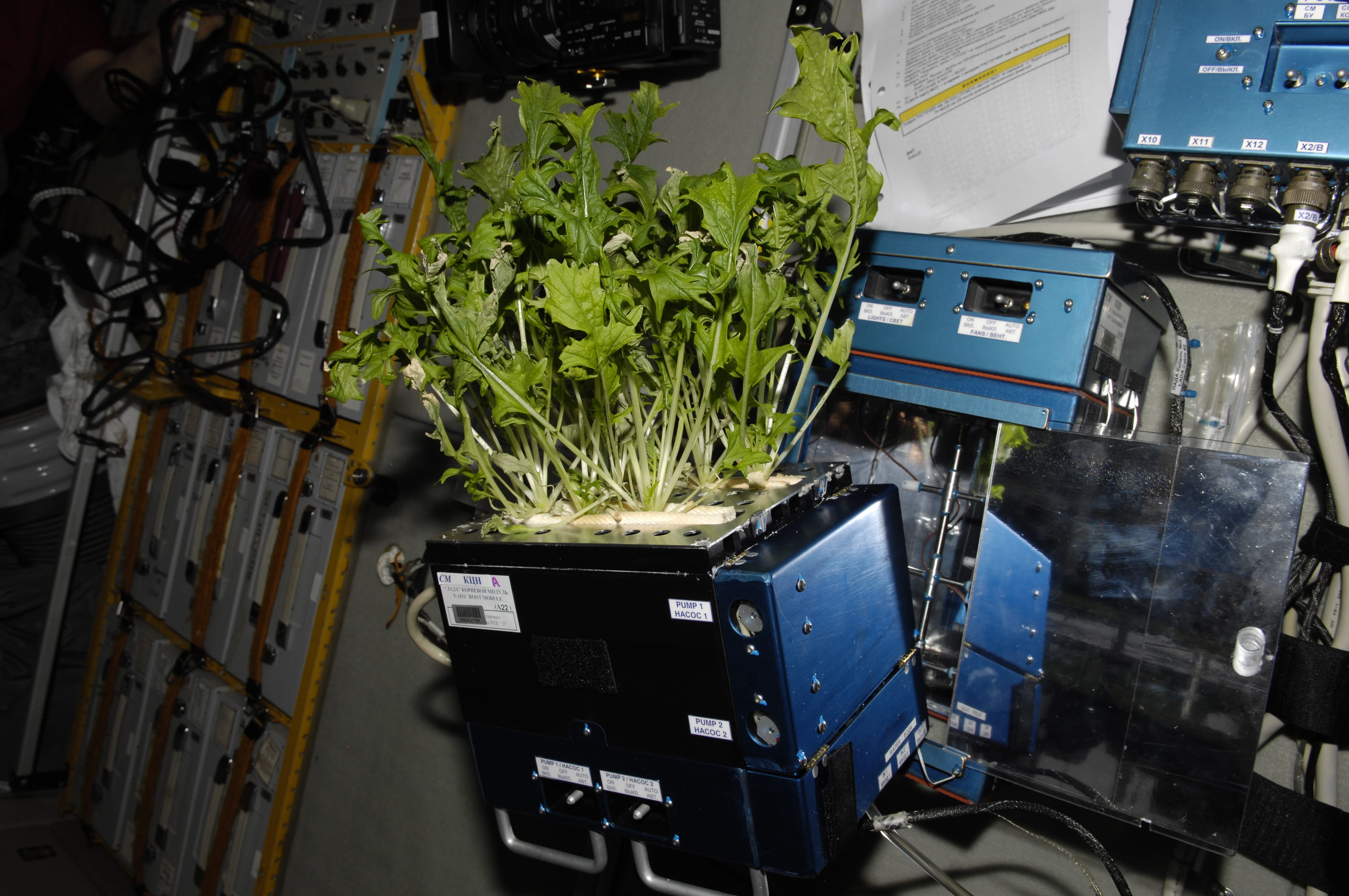
Design and ground testing of a Zero-Discharge plant growth system for microgravity Applications
Key Words: Microgravity • Space agriculture • Automated fertigation • Re-planting • Water Use Efficiency • Mizuna • Moisture sensors
The study, published in Computers and Electronics in Agriculture and co-authored by West Point faculty member Sarah Schreck, details the design and ground testing of the Utah Reusable Root Module (URRM) system developed for space-based agriculture within NASA’s Ohalo III Crop Production System. Researchers engineered a zero-discharge, automated fertigation framework equipped with redundant soil moisture sensors and innovative top cover containment designs to manage water, nutrients, and gas distribution in a microgravity environment. Preliminary ground tests utilizing Mizuna demonstrated that the system reliably maintained target soil moisture ranges and uniform resource distribution without manual intervention, successfully yielding over 1 kg of fresh edible biomass. These findings highlight the URRM’s capacity to support semi-autonomous, high-efficiency crop production across continuous cycles, significantly strengthening the feasibility of life-support systems for long-duration human space exploration.
To cite this article: Garrido-Ruiz, C., González-Teruel, J. D., Dixon, C., Schreck, S., Bingham, C., Winward, T., Hutchings, R., Bingham, G. E., Bugbee, B., & Jones, S. B. (2025). Design and ground testing of a Zero-Discharge plant growth system for microgravity Applications. Computers and Electronics in Agriculture, 239, Article 111044. https://doi.org/10.3354/esr01429
Want to know more? Click here to read the full paper!

Sounds of Atlantic sturgeon spawning: first description and opportunities for riverine endangered species conservation with passive acoustic monitoring
Key Words: Bioacoustics • Anadromous fish • Spawning aggregation • Fisheries management • Acipenser oxyrinchus
The study, published in Endangered Species Research and co‑authored by Environmental Science Program faculty member Dr. Patrick Baker, provides the first confirmed description of Atlantic sturgeon (Acipenser oxyrinchus) spawning sounds in the Hudson River. Researchers identified a distinctive 44 Hz low‑frequency signal that reliably aligned with telemetry‑tagged adults during spawning periods, with captive recordings validating the same acoustic cue. These findings highlight passive acoustic monitoring as a powerful, non‑invasive tool for detecting spawning aggregations, tracking habitat use, and improving conservation strategies for this endangered species. By establishing a new biological indicator, the study expands the role of bioacoustics in freshwater fisheries management and endangered species recovery.
To cite this article: Cohen R, Baker PJ, Bowser C, Breece MW, Flecker A, Fox D, Henne J, Higgs A, Niemistö M, Pendleton R, Sethi SA, White SL, Rice A. 2025. Sounds of Atlantic sturgeon spawning: first description and opportunities for riverine endangered species conservation with passive acoustic monitoring. Endanger Species Res. 14(2):127–135. https://doi.org/10.3354/esr01429
Want to know more? Click here to read the full paper!
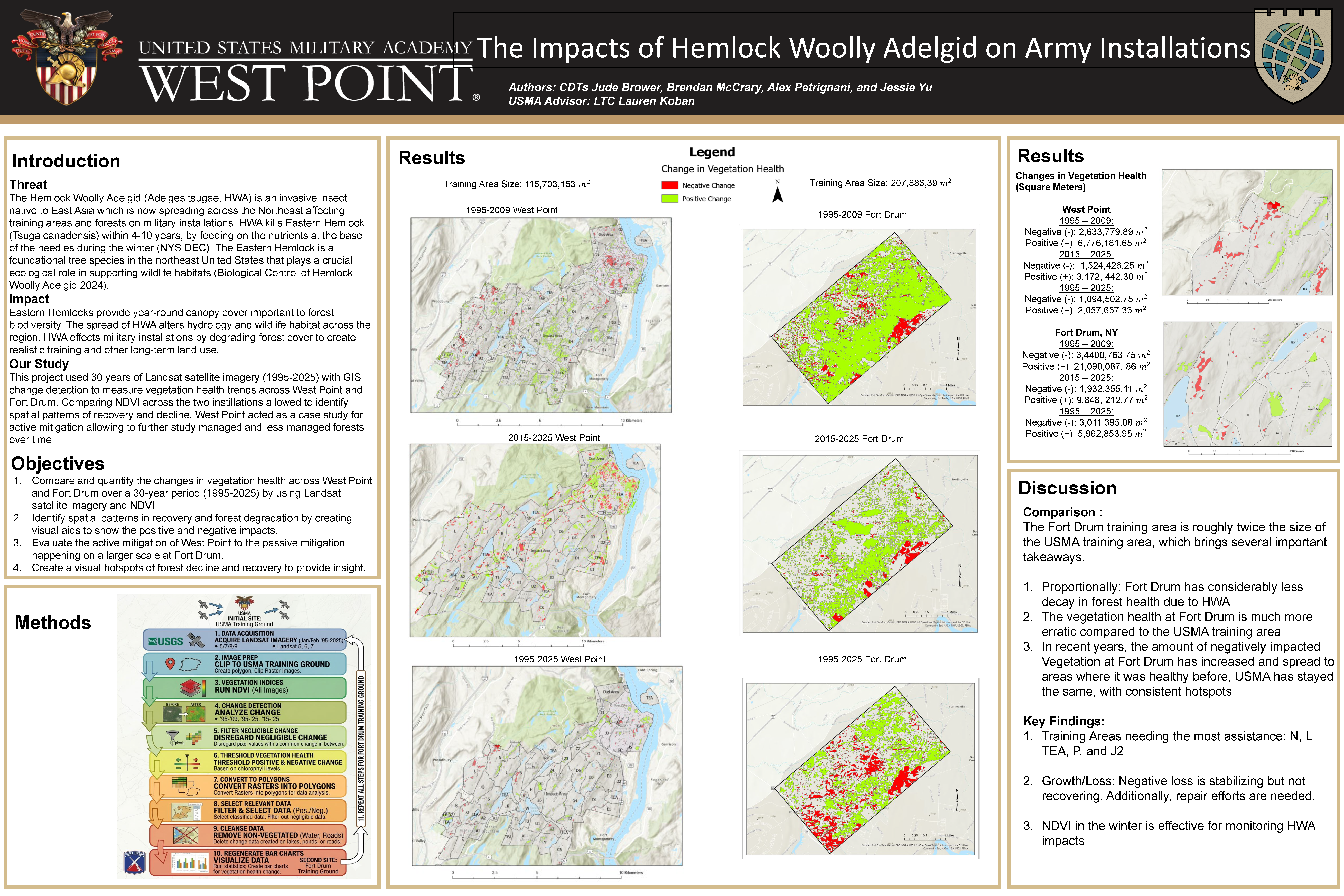
The Impacts of Hemlock Woolly Adelgid on Army Installations
Introduction
Threat
The Hemlock Woolly Adelgid (Adelges tsugae, HWA) is an invasive insect native to East Asia which is now spreading across the Northeast affecting training areas and forests on military installations. HWA kills Eastern Hemlock (Tsuga canadensis) within 4-10 years, by feeding on the nutrients at the base of the needles during the winter (NYS DEC). The Eastern Hemlock is a foundational tree species in the northeast United States that plays a crucial ecological role in supporting wildlife habitats (Biological Control of Hemlock Woolly Adelgid 2024)